


Table of Contents
What is an Honorary Doctorate Degree? Who can facilitate an Honorary Doctorate in India? Who is eligible for an Honorary Doctorate Degree? 1. Selfless and excellent contribution to society 2. Expertise in any specific industry 3. Honourable public reputation 4. Long-term results 5. Green flag from university authorities What are the advantages of an Honorary Doctorate Degree? 1. Recognition and Reputation 2. Upgraded Personal Brand 3. Increased public trust 4. The urge to continue the contribution 5. Building Connections 6. A lasting legacy What are the limitations of an Honorary Doctorate Degree? What are the characteristics of a genuine Honorary Doctorate Degree? Who is nominated to receive an Honorary Doctorate Degree? Conclusion:Have you met people who use “Dr” in front of their name, even though they have never studied the medical field in their life? Sometimes the reason for this is an Honorary Doctorate Degree. This special award is facilitated for the people who have selflessly given their lives to work for the betterment of society and the world. The people who have great achievements in the fields of arts, science, business, or society without spending years in a classroom are given this award.
If you look at India, honorary doctorates are becoming popular and common every year. Many universities are facilitating them for actors, business heads, social workers, sportspeople, and other big personalities. Still, there are many people who get confused about the real meaning behind this degree. They are still confused about the benefits it has, the challenges it brings, its eligibility criteria, and its process. This article will explain everything to you in clear and simple words.
What is an Honorary Doctorate Degree?
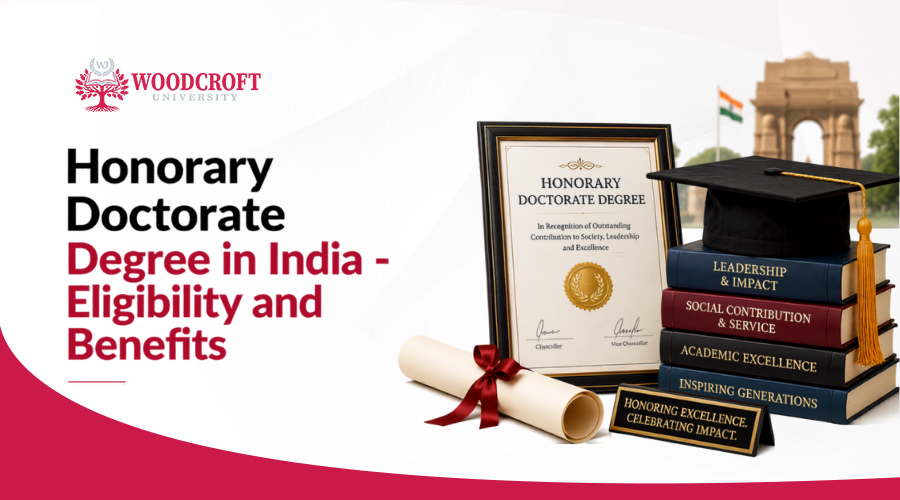
The first question arises: what is an Honorary Doctorate Degree? An honorary doctorate is a degree that is given by a school or a university to honour an individual’s selfless contribution to society. It is not like the traditional earned degrees. Unlike them, this degree does not require regular classes, tests, or any research work like a normal PhD. Instead, it is a form of recognition and respect from the university towards the candidate.
Imagine this is an award. Just like a cinema award is given to respect good acting, an Honorary Doctorate Degree is given to respect a person’s impact on the world and society. The impact could be through the fields of science, arts, business, social service, or public leadership.
You must understand one core point completely: an honorary doctorate is not the same thing as an academic PhD. An academic PhD requires years of research, drafting, and testing of new ideas. An honorary doctorate does not require any of these things. It is completely given out to respect and honour.
Who can facilitate an Honorary Doctorate in India?
In India, an honorary doctorate is taken very seriously. Not any organisation can give it out; only the universities that are officially registered under the UGC Act, 1956, are legally allowed to confer an Honorary Doctorate Degree. The University Grants Commission (UGC) is the government body that creates and regulates rules for higher education in India. It also sets rules about how these degrees can be conferred.
The following are some of the important factors that you must remember about an Honorary Doctorate Degree:
- Only the universities that are recognised under the UGC Act can legally award an Honorary Doctorate Degree.
- The degree must be conferred using proper university procedures and internal approvals.
- An actual and real honorary doctorate is generally given in an official and professional convocation or a special ceremony. It is not done entirely online.
You can also read about how to get an Honorary Doctorate Degree in detail here.
Who is eligible for an Honorary Doctorate Degree?
An Honorary Doctorate Degree is a lot different from the regular earned degrees. Unlike a regular degree, there is no syllabus or course code for an honorary doctorate. Instead, the schools or universities look at the person’s achievements and their selfless contributions to society and decide if they deserve this recognition or not. But every university has its own process and rules. The following are some of the most common and general eligibility requirements for an honorary doctorate:
1. Selfless and excellent contribution to society
The person who has been nominated for the honorary doctorate must have contributed something meaningful to society. This meaningful contribution can include social work, charity, community service, or things that have improved the living status of needy people.
2. Expertise in any specific industry
Many recipients might not have contributed to social services, but they do have contributions to specific fields like science, medicine, literature, business, sports, or arts. If their work has made any significant change in the world or to society, they do deserve this award as a form of honour.
3. Honourable public reputation
When a university decides to confer an Honorary Doctorate Degree, their reputation depends a lot on who they are choosing to give this award to. The candidate must have a clean and respected reputation among people. Universities are very careful about who they choose to honour with the award. This award holds recognition and value to its name, which is why the schools or universities prefer candidates with a respected reputation to confer.
4. Long-term results
Receiving an Honorary Doctorate Degree is an achievement that will last forever with your name. This is why the impact that you have created must be a long-term impact. The contribution should not be a one-time event. The candidate must have done something to create long-term changes for the betterment of society.
5. Green flag from university authorities
There might be candidates that meet all the above points, but the final decision still relies on the authorities of the specific universities. The governing bodies of the university, such as the admission council or the board of management, decide on the final candidate for an honorary doctorate. Their process includes reviewing the nomination and approving the final candidate through an official process.
The noticeable thing is that there is no age limit, educational background, or fixed profession. To get an honorary doctorate, you just need to have a selfless contribution to society. People who come from very different fields in life or those who do not have a professional degree have still received an Honorary Doctorate Degree for their real-life achievements.
What are the advantages of an Honorary Doctorate Degree?
An Honorary Doctorate Degree does not come with any academic value. Unlike traditional earned degrees, an honorary doctorate does not give you any academic leverage, but it does come with some exciting advantages. The following are some of the most popular and common benefits of an Honorary Doctorate Degree:
1. Recognition and Reputation
The biggest and most popular benefit of receiving an honorary doctorate is the immense public reputation. If you are awarded an Honorary Doctorate Degree, you will get recognition with your name forever. The media will cover you, and people will notice your achievements.
2. Upgraded Personal Brand
Public figures who have been making public contributions need to grow their personal brand too. Public figures, brand heads, and social workers can enhance their personal image with the honorary doctorate title. It displays that their efforts are seen, respected, and valued by the public and the academic institution too.
3. Increased public trust
An Honorary Doctorate Degree is a public recognition. When you receive it, every news channel covers you, and everyone gets to know about it. A large number of people start trusting you and your work. Even your personal brand gains followers and audiences. When people see the “Dr” title as a sign of credibility, they automatically trust your reliability.
4. The urge to continue the contribution
A person requires appreciation and motivation to continue the good work they have been doing for society. Receiving an Honorary Doctorate Degree becomes a reason for continuing their selfless contribution to society. It is like a source of encouragement for them to continue their selfless work.
5. Building Connections
An Honorary Doctorate Degree is given in an official convocation ceremony. The convocation ceremony usually includes senior academics, government officials, and other contributors. Receiving an award in their presence creates exciting opportunities for the candidate and the university to build stronger connections with such public figures.
6. A lasting legacy
An Honorary Doctorate Degree is not any random award. It displays years of hard work and the selfless contribution of an individual. For many people, it is a symbol of a lasting legacy that will go on for generations. It becomes a lasting source of pride and happiness for many recipients.
What are the limitations of an Honorary Doctorate Degree?
Everything that has various advantages will have at least one disadvantage too. An Honorary Doctorate Degree has lots of benefits for an individual’s life and career, but it has some limitations that you must know. The following are some of the most important limitations that you must know:
- No academic worth: An honorary doctorate gives the “Dr” title in front of your name, but there is no academic value attached to it. This title will not represent you as an academic genius or will not show your education.
- Cannot help you with jobs or promotions: This degree will surely give you recognition, but that will be a very selective recognition. You will not be able to use it in every field. It will not help you in any way to either acquire a job or a job promotion.
- Limited usage of the "Dr" title: The most exciting part of an Honorary Doctorate Degree is the “Dr” title that comes along with it. But this title cannot be used anywhere at any time. This title is different from the PhD title, which is why its importance and usage become limited.
- The fake honorary degree scam: An Honorary Doctorate Degree is the highest honour that anyone can achieve. This is why many unrecognised and fraudulent organisations promise a fake honorary doctorate which has no value.
What are the characteristics of a genuine Honorary Doctorate Degree?
There are so many fake honorary doctorates circulating that the real ones are getting difficult to find. Everyone needs to know the authentication factors of an Honorary Doctorate Degree, so that they can spot a fake one and save themselves. The following are some of the most important traits of a genuine Honorary Doctorate Degree:
- Make sure that the university facilitating the award is officially registered under the UGC. This information is publicly available on the UGC website.
- Check if the university is having a proper convocation to give an honorary doctorate or is just asking for an online payment.
- The university must offer a nomination and approval process rather than offering you an instant honorary doctorate.
- Make sure you have done your research about the university’s history and their past recipients so that you know that the university honours individuals only.
If you are careful about these points and take care of them before you accept any university’s offer for an honorary doctorate, you can easily save yourself from the scams going around.
Who is nominated to receive an Honorary Doctorate Degree?
Plenty of famous folks in India have honorary degrees. You will see them among business leaders, actors, and scientists. Schools pick people who do things that help the country. Some improve health. Others make art. It shows that these awards are not just for one type of work. They celebrate success wherever it pops up. That could be in a lab. Or a movie studio. It might even be a small project in a village. If you do something big, these awards find you.
Conclusion:
An Honorary Doctorate Degree is a meaningful way for universities in India to recognise people. Universities in India give out honorary doctorates to thank people for helping others. This is different from the PhD students earn by studying for years. You don't need to do research or take any exams. The degree is about how much you helped your community. A school board usually looks at what you have done for the public and checks your name before they ever say yes, which keeps things fair. You can't use the title to get a promotion or show you have new job skills. It is just about the honour. People see it and get inspired. Always make sure the school follows the UGC rules. The process must be clear. When you get it the right way, it is a big win. That degree shows you did something real and did not just buy a name for yourself.
Frequently Asked Questions
"I am Brandon Johnson, a professional content writer who creates informative content about online education, digital learning platforms, and career-focused courses. I aim to help readers find the best opportunities in modern education."
Brandon Johnson