


Top 10 Benefits of Data Science in 2025 | Why It M...
Top 10 Benefits of Data Science in 2025 | Why It M...

Woodcroft University was founded with a mission to make high-quality education accessible to learners everywhere. Built for the digital era, Woodcroft embraces innovation, flexibility, and global connection, offering students a modern academic experience grounded in excellence. Through immersive online learning, industry-aligned programs, and a diverse international community, Woodcroft continues to empower learners to grow, advance, and create meaningful impact in their fields.




TThe Faculty of Engineering, Robotics & Applied Sciences (FERAS) at Woodcroft University redefines how engineering is learned in a digital world. Our programs blend theory, simulation, and virtual experimentation to prepare engineers for a future driven by automation, robotics, and intelligent systems.
Every course—whether a short professional certificate or a full doctoral program—is delivered through an interactive online model supported by cloud-based design tools, remote laboratories, and real-time collaboration platforms. Learners graduate with practical competencies ready for applications in manufacturing, renewable energy, mechatronics, construction technology, and advanced automation.


“Modern engineering is no longer confined to the workshop; it’s powered by simulation, automation, and global collaboration. Our faculty helps engineers design the future—virtually, intelligently, and sustainably.”
Students learn to prototype, test, and optimize systems using virtual design tools and simulation software mirroring real-world industrial conditions.
Graduates emerge as multidisciplinary professionals capable of managing smart manufacturing, automation systems, and sustainable engineering projects across industries.
The programs foster innovation in renewable energy, robotics, and IoT, encouraging research that builds efficient, ethical, and human-centric technologies.
If you missed the weekend performances, you can catch the Singing Quakers Christmas Candlelight Concert on December 7 and 8. Visit friends.edu/finearts for more information.


Covers circuits, power systems, renewabl... Covers circuits, power systems, renewable energy integration, and embedded electronics using digital simulation environments. Read More
Details
Focuses on thermodynamics, fluid mechani... Focuses on thermodynamics, fluid mechanics, CAD modeling, and product design—all executed through 3D virtual labs. Read More
Details
Centers on robotic control systems, auto... Centers on robotic control systems, automation algorithms, sensors, and human-machine collaboration through online robotic simulators. Read More
DetailsResearch on smart grids, embedded systems, and advanced computational design.
Practice-based doctorate combining applied research with leadership in industrial innovation.
Integrates mechanical systems, sensors, and intelligent automation for next-generation robotics.
Deep dive into circuit design, power distribution, and energy efficiency with live online labs.
Explores autonomous control, embedded IoT architecture, and cloud-linked robotic systems.
Postgraduate program focusing on design thinking, CAD/CAM, and product lifecycle simulation.
Practical program covering PLCs, SCADA, and real-time process automation.
Teaches hardware-software integration and sensor-network configuration for connected devices.
Foundation program providing multidisciplinary technical skills for entry-level engineers.
Focuses on 3D modeling, visualization, and rapid-prototyping using professional CAD software.
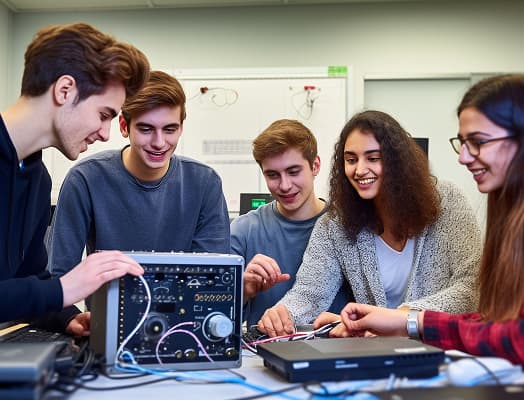
Online Engineering Lab Complex – Cloud-based lab suite for circuit design, mechanical simulation, and robotics coding.
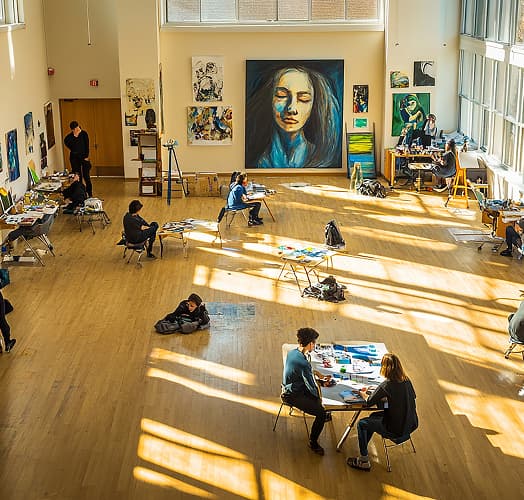
3D Modeling Studio – Remote workstation for CAD drawing, prototyping, and rendering.
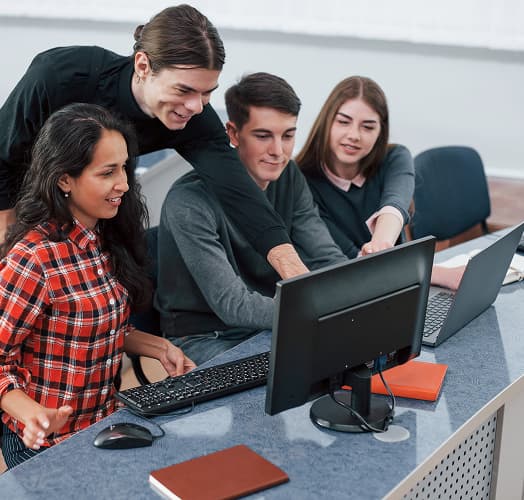
Automation & IoT Sandbox – Virtual environment to test PLC logic, IoT sensor data, and process control systems.
Digital Fabrication Workshop – Guided space for additive-manufacturing and product-development projects.
Research Collaboration Hub – Platform connecting doctoral students with mentors on sustainability, robotics, and AI applications.
Programs developed for real-world engineering application through digital simulation.
Multidisciplinary curriculum connecting mechanical, electrical, civil, and automation streams.
Flexible progression from certificate to doctorate levels.
Faculty with strong research and industry backgrounds guiding every project.
Focus on sustainable, data-driven, and innovation-oriented engineering solutions.
Virtual internships and live capstone projects with global industrial partners.

Dec, 2025
Top 10 Benefits of Data Science in 2025 | Why It M...
Dec, 2025
Explore the vibrant university life at Woodcroft U...

