

Woodcroft University was founded with a mission to make high-quality education accessible to learners everywhere. Built for the digital era, Woodcroft embraces innovation, flexibility, and global connection, offering students a modern academic experience grounded in excellence. Through immersive online learning, industry-aligned programs, and a diverse international community, Woodcroft continues to empower learners to grow, advance, and create meaningful impact in their fields.



The Doctorate in Cognitive Systems at Woodcroft University is a terminal professional doctorate designed for senior technology professionals, researchers, system architects, AI leaders, neuroscientists, and academic–industry practitioners seeking to apply advanced research to complex, real-world problems involving intelligent systems, human–machine interaction, and cognition-driven technologies.
The program bridges the gap between cognitive science, artificial intelligence, and applied system design, enabling professionals to generate actionable, research-driven insights that inform the development of adaptive systems, intelligent decision-making architectures, autonomous technologies, and next-generation human-centric computing solutions.
Unlike a traditional PhD, the Doctorate in Cognitive Systems emphasizes practice-based and systems-oriented research, focusing on applied problem-solving in areas such as cognitive architectures, intelligent agents, machine perception, human–AI interaction, computational cognition, neuro-inspired systems, and emerging cognitive technologies. Learners engage in rigorous doctoral-level coursework while conducting original research aligned with their professional context, organization, or applied research domain.
Delivered through a 100% online doctoral learning model, the program integrates structured research seminars, advanced cognitive systems modules, faculty-led supervision, and independent dissertation work. Candidates develop expertise in research design, computational and experimental methodologies, systems modeling, cognitive analytics, and scholarly communication—culminating in a doctoral thesis or practice-based dissertation that contributes both academic value and real-world technological impact.
The Doctorate in Cognitive Systems curriculum is aligned with international doctoral standards and interdisciplinary research frameworks, preparing graduates for senior roles in advanced technology leadership, applied research, system architecture, policy advisory positions, and professional or academic teaching tracks. The program also supports professionals aiming to influence innovation strategy, lead complex intelligent-system initiatives, or publish applied research in peer-reviewed journals and professional outlets.
The Doctorate in Cognitive Systems at Woodcroft University is ideal for professionals who seek to deepen their expertise in intelligent systems, strengthen their research credibility, and lead the design and governance of cognition-driven technologies in an increasingly complex, AI-enabled global environment.
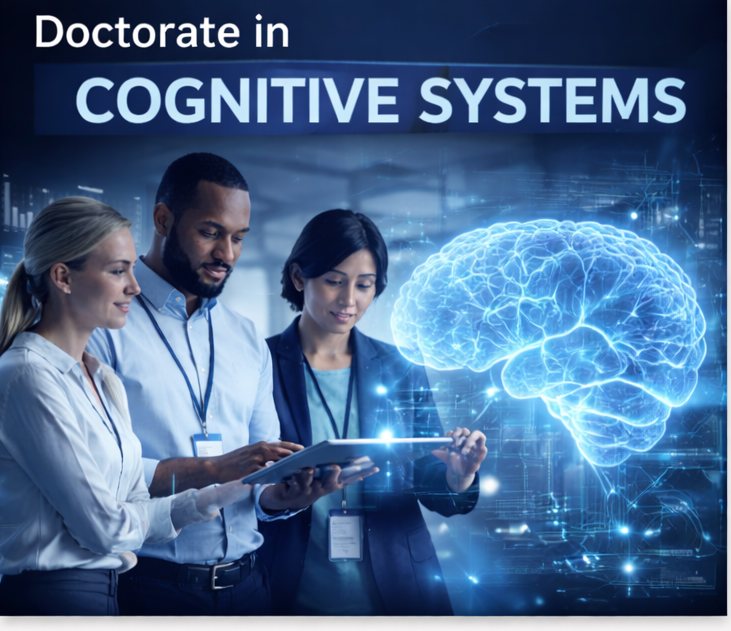

Unlike purely theoretical doctoral degrees, Woodcroft University’s Doctorate in Cognitive Systems emphasizes applied, interdisciplinary research at the intersection of artificial intelligence, human cognition, decision sciences, and intelligent systems design. The program equips candidates to address real-world challenges involving human–machine interaction, autonomous systems, cognitive architectures, and intelligent decision-making—making it ideal for leaders shaping the future of AI-enabled systems.
Designed specifically for working professionals, the Doctorate in Cognitive Systems is delivered through Woodcroft’s 100% online doctoral learning platform. Candidates benefit from recorded research seminars, live faculty-led discussions, guided supervision, and structured research milestones—allowing them to pursue advanced doctoral study without interrupting their professional careers in technology, research, or leadership roles.
Doctoral candidates undertake original, practice-driven research focused on contemporary challenges such as cognitive AI, human-centered AI systems, explainable intelligence, autonomous decision frameworks, adaptive learning systems, and ethical cognitive computing. Research outcomes are designed to deliver measurable impact across industries while contributing to applied knowledge in cognitive systems and emerging technologies.
Candidates receive dedicated supervision from experienced doctoral faculty and research mentors with strong credentials across AI, cognitive science, systems engineering, neuroscience-informed computing, and industry-led innovation. Faculty guide candidates through research design, methodology, experimentation, validation, and doctoral thesis development—ensuring academic rigor, relevance, and clarity throughout the research journey.
The Doctorate in Cognitive Systems at Woodcroft University is structured around a global, interdisciplinary lens, integrating perspectives from artificial intelligence, psychology, neuroscience, data science, ethics, and systems engineering. This prepares graduates to operate effectively in multinational organizations, advanced research labs, technology consultancies, policy environments, and global innovation ecosystems.
The program follows a clearly defined doctoral framework, including coursework in cognitive systems theory, advanced research methodology, AI ethics, experimental design, and systems modeling, followed by proposal development, ethics approval, data collection or system validation, dissertation writing, and final defense. This structured approach supports timely progression while maintaining doctoral-level academic standards.
The Doctorate in Cognitive Systems is tailored for professionals seeking advancement into chief AI roles, research leadership positions, advanced consultancy, policy advisory roles, and academic leadership in applied technology domains. The program strengthens systems thinking, research literacy, interdisciplinary integration, and executive influence across technology-driven industries.
Woodcroft University’s Doctorate in Cognitive Systems maintains strong academic integrity while remaining professionally relevant and outcome-focused. Graduates develop advanced analytical, systems-level reasoning, and research capabilities that enhance their credibility within corporate R&D, AI leadership, consulting, and academic–industry practice environments.
Woodcroft University emphasizes capability development, applied research excellence, and professional growth rather than unrealistic career guarantees. The Doctorate in Cognitive Systems empowers candidates with advanced knowledge, research confidence, and systems insight to design, evaluate, and lead intelligent systems with real-world impact.
Choosing the Doctorate in Cognitive Systems at Woodcroft University means investing in a doctoral program that respects your professional experience, strengthens your strategic and technological impact, and positions you as a thought leader in intelligent systems and human–AI collaboration.
Advance your leadership and research journey with Woodcroft University—
where cognitive science meets advanced artificial intelligence and doctoral excellence.
Demonstrate the ability to analyze complex cognitive, computational, and socio-technical systems, evaluate intelligent system architectures, and make evidence-based decisions that enhance system performance, adaptability, and human–machine collaboration.
Design, conduct, and defend original applied doctoral research that integrates cognitive science, artificial intelligence, machine learning, and systems theory to address real-world challenges in intelligent systems, automation, and human-centered technologies.
Lead large-scale initiatives involving human–AI interaction, cognitive modeling, and adaptive systems by applying advanced theories from cognitive psychology, neuroscience-inspired computing, and systems engineering.
Apply advanced quantitative, qualitative, and computational research methods—including cognitive modeling, behavioral analytics, and machine learning—to interpret complex cognitive data and optimize intelligent system outcomes.
Evaluate and implement ethical frameworks, governance models, and regulatory compliance strategies for cognitive systems, ensuring responsible AI deployment, transparency, trust, and societal alignment.
Drive innovation by leveraging cognitive computing, autonomous systems, neuro-inspired AI, and emerging intelligent technologies to design scalable, adaptive, and future-ready solutions across industries.
Analyze global technological ecosystems, geopolitical implications of AI and cognitive systems, and international policy environments to formulate resilient, cross-border technology strategies.
Develop and evaluate advanced strategies for value creation through cognitive systems—optimizing investment decisions, system architectures, and intelligent automation to deliver measurable organizational and societal impact.
Produce doctoral-level scholarly writing, technical research reports, and executive-level presentations that clearly communicate complex cognitive systems research to academic, industry, and policy audiences.
Demonstrate the highest standards of professional integrity, ethical judgment, and social responsibility in the design, research, and leadership of cognitive and intelligent systems.
Upon completion of the Doctorate in Cognitive Systems, graduates will be prepared to:
The Doctorate in Cognitive Systems is an advanced academic doctoral program designed to develop deep theoretical, computational, and research expertise in cognitive science, artificial intelligence, intelligent systems, and human–machine cognition.
The program emphasizes original scholarly research, advanced interdisciplinary theory, and rigorous methodological training, enabling doctoral candidates to investigate complex cognitive phenomena and design next-generation intelligent systems.
Structured in progressive doctoral phases, the curriculum aligns with international PhD-level standards, supporting candidates from foundational research training through dissertation completion and scholarly contribution.
This phase establishes the theoretical, philosophical, and methodological foundations required for doctoral research in cognitive systems.
Core Areas:
Outcome:
Candidates develop a clearly defined research problem, grounded in theory and supported by a doctoral-level research proposal.
This phase deepens theoretical and technical expertise across key domains of cognitive and intelligent systems.
Core Areas:
Outcome:
Learners achieve advanced mastery of cognitive systems theory and computational intelligence frameworks.
This phase focuses on conducting original doctoral research supported by advanced analytical and computational techniques.
Core Areas:
Outcome:
Candidates generate original research findings that contribute to the academic advancement of cognitive systems and intelligent technologies.
The final phase is dedicated to completing, submitting, and defending the doctoral dissertation.
Key Components:
Outcome:
Graduates demonstrate independent research capability and contribute novel knowledge to the field of cognitive systems.
Learning Methodology
The Doctorate in Cognitive Systems is delivered through a 100% online, research-intensive doctoral learning model.
Learning Elements Include:
Skills & Competencies Developed
Graduates develop advanced academic and research competencies, including:
Career & Academic Outcomes
Graduates are prepared for advanced roles such as:
*Subject to regional academic regulations.
Admission Requirements for Doctorate in Cognitive Systems
The Doctorate in Cognitive Systems is a rigorous, research-intensive doctoral program designed for scholars, researchers, technologists, and interdisciplinary professionals seeking to advance theoretical and applied knowledge at the intersection of cognitive science, artificial intelligence, neuroscience, computational modeling, and intelligent systems.
The admission framework ensures that candidates possess strong academic foundations, research aptitude, and the intellectual maturity required for advanced doctoral-level study and original scholarly contribution.
Educational Qualifications
✔ A Master’s degree from a recognized institution in one or more of the following fields:
– Cognitive Science
– Artificial Intelligence
– Computer Science
– Data Science
– Neuroscience
– Psychology
– Computational Science
– Robotics
– Human–Computer Interaction
– Systems Engineering
– Philosophy of Mind
– Linguistics (with computational focus)
– Or a closely related interdisciplinary field
✔ Applicants with strong interdisciplinary academic backgrounds may be considered subject to academic review
✔ Consistent and strong academic performance in prior undergraduate and postgraduate studies is expected
✔ Demonstrated ability to engage in theoretical, computational, or experimental research
✔ Prior exposure to research methodologies, statistical analysis, computational modeling, or empirical experimentation is highly desirable
✔ Applicants should show a clear interest in advancing knowledge related to intelligence, cognition, learning systems, perception, reasoning, or autonomous systems
✔ Previous research experience, thesis work, conference papers, or publications is advantageous
✔ Professional experience in AI, research labs, technology, healthcare, cognitive sciences, or computational domains may strengthen an application
✔ Industry or applied experience is not required and does not replace academic readiness
✔ The program remains academically oriented, with research merit as the primary criterion
✔ Applicants whose prior education was not conducted in English may be required to demonstrate English language proficiency
✔ Proof may include standardized language test scores or evidence of English-medium academic instruction
✔ Doctoral-level reading, writing, and scholarly communication skills in English are essential
✔ Completed online doctoral application form
✔ Academic transcripts and degree certificates (Bachelor’s and Master’s levels)
✔ Statement of Purpose (SOP) clearly outlining:
– Research interests in cognitive systems
– Academic background and preparation
– Intended research direction
– Long-term scholarly or research goals
✔ Updated academic CV highlighting:
– Education
– Research experience
– Publications (if any)
– Technical skills
– Academic projects
✔ Government-issued photo identification for verification
✔ A preliminary research proposal or structured research intent statement is strongly recommended
✔ The proposal should demonstrate:
– Conceptual clarity
– Research relevance
– Awareness of existing literature
– Methodological direction
– Potential contribution to the field of cognitive systems
✔ Final research topics and scope will be refined under faculty supervision after enrollment
✔ Applications are reviewed by the Doctoral Admissions & Research Committee
✔ Evaluation focuses on:
– Academic preparedness
– Research potential
– Conceptual rigor
– Alignment with faculty expertise
– Ability to sustain long-term doctoral research
✔ Shortlisted candidates may be invited for a research interview or academic discussion
✔ Candidates from adjacent disciplines may be offered research foundation or bridge modules to strengthen theoretical or computational readiness
✔ The program supports interdisciplinary backgrounds while maintaining strict doctoral-level academic standards
The Doctorate in Cognitive Systems is ideal for:
✔ Aspiring and established researchers in cognitive science, AI, and intelligent systems
✔ Academics seeking advanced doctoral credentials in interdisciplinary cognitive research
✔ AI researchers focused on cognition-inspired architectures and learning systems
✔ Professionals transitioning into full-time or part-time academic research careers
✔ Scholars aiming to contribute to theoretical, experimental, or computational understanding of intelligence and cognition
This doctoral program is globally aligned, research-driven, and designed to prepare candidates for academic, research, and advanced innovation-focused careers at the highest scholarly level.


